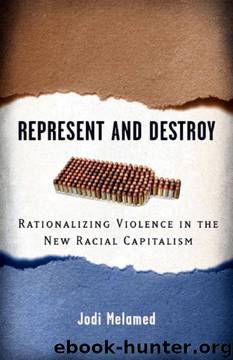
Represent and Destroy: Rationalizing Violence in the New Racial Capitalism (Difference Incorporated) by Jodi Melamed
Author:Jodi Melamed
Language: eng
Format: epub
Published: 2012-02-07T05:20:00+00:00
Those Bones Are Not My Child as a Survival Guide for Liberal-Multicultural Times
In The Evidence of Things Not Seen, James Baldwin described the Atlanta youth murders as a rupture in which invisible yet deadly global processes of race, authority, and economy became visible in the murdered bodies of precious children from Atlanta's black working-class neighborhoods. "The present social and political apparatus cannot serve human need," Baldwin wrote. "It is this apprehension that ferments in multitudes today, looking at the bodies of their menaced and uselessly slaughtered children, all over this world, in Atlanta, and from sea to shining sea."35 Bambara's novel made a similar intervention. It represented community activism during the murders as the last stand of 1970s social movement organizing in urban African American communities and exemplary of the kinds of discursive constraints and repressive tactics that in the 198os drove underground the production of antiracist materialist knowledges, especially Black Power, third-world Left, and women-of-color feminist orientations. In memorializing this moment of shutting down, Those Bones paradoxically preserved (and could teach readers about) the daily practices that sustained social movements and how people integrated subjugated and undersiege knowledges and interpretative tendencies into their daily lives.
Remarking upon the educative and strategic functions of the novel, Joyce Ann Joyce proposed using Those Bones as a model for black studies. Considering that knowledge production at U.S. universities today continues to be fashioned to transmit and implant liberal multiculturalism as an official antiracism, we might also propose using Those Bones as a model for how to carry on the work of insurgent black studies outside the university, even as the contest continues over the university as an apparatus for validating knowledge about African American communities and racial difference.
Working inside and outside the universitywas something Bambara did her whole life. During the mid-196os, when Bambara (working inside and outside the Black Arts movement) began to write and publish short stories, she was also serving as program director of the Colony House Community Center in New York City and teaching in the City University of New York's City College Search for Education, Elevation, Knowledge (SEEK) program. As an assistant professor at Rutgers University (Livingston Campus) from 1969 to 1974, Bambara also organized black student groups and arts groups and won a service award from Livingston's black community. Bambara moved to Atlanta in 1974 to join a thriving Black Arts and black feminist community centered around the city's historically black colleges and universities. Bambara was a writer in residence at Spelman College (1978-1979), an assistant professor of Afro-American studies at Emory (1977), and an instructor in the School of Social Work at Atlanta University (1977-1979). Her first position in Atlanta was, however, as writer in residence at the Neighborhood Arts Center (1975-1979), whose explicit mission was community building through art. During her time in Atlanta, Bambara also cofounded Sojourner South, which was an ad hoc political coalition of influential black women, and the Southern Collective of African American Writers.36
Bambara experienced the Atlanta youth murders (also known
Download
This site does not store any files on its server. We only index and link to content provided by other sites. Please contact the content providers to delete copyright contents if any and email us, we'll remove relevant links or contents immediately.
| Anthropology | Archaeology |
| Philosophy | Politics & Government |
| Social Sciences | Sociology |
| Women's Studies |
Nudge - Improving Decisions about Health, Wealth, and Happiness by Thaler Sunstein(7712)
The Fire Next Time by James Baldwin(5454)
iGen by Jean M. Twenge(5419)
Adulting by Kelly Williams Brown(4582)
The Sports Rules Book by Human Kinetics(4398)
The Hacking of the American Mind by Robert H. Lustig(4387)
The Ethical Slut by Janet W. Hardy(4262)
Captivate by Vanessa Van Edwards(3843)
Mummy Knew by Lisa James(3695)
In a Sunburned Country by Bill Bryson(3547)
The Worm at the Core by Sheldon Solomon(3490)
Ants Among Elephants by Sujatha Gidla(3469)
The 48 laws of power by Robert Greene & Joost Elffers(3299)
Suicide: A Study in Sociology by Emile Durkheim(3025)
The Slow Fix: Solve Problems, Work Smarter, and Live Better In a World Addicted to Speed by Carl Honore(3015)
The Tipping Point by Malcolm Gladwell(2931)
Humans of New York by Brandon Stanton(2876)
Get What's Yours for Medicare: Maximize Your Coverage, Minimize Your Costs by Philip Moeller(2764)
Handbook of Forensic Sociology and Psychology by Stephen J. Morewitz & Mark L. Goldstein(2709)
